![coworking-space-desk-_-my-blog-2026-_-cl-2026.jpg]()
Artificial intelligence has quietly changed job descriptions. A year ago, it drafted your emails. Now it researches, summarises, analyses data, and produces first drafts of work that used to occupy entire afternoons. The more interesting question is not which tasks it absorbs next, but what that leaves for people, and what kind of space that remaining work actually needs. The future workplace is being reshaped by that question right now, and the answer looks less like a floor plan and more like a set of capabilities.
For business owners and team leaders in Malaysia, this matters commercially. Office decisions made today usually lock in three to five years of cost. Understanding where work is heading is the difference between committing to space that fits the last decade and building something that flexes with the next one.
What the Future Workplace Actually Means
The most useful definition is the least architectural. Tomorrow's office is not primarily a place; it is the ability to do focused, collaborative and client-facing work from wherever it makes sense, supported by the right infrastructure. Location becomes one option among several rather than the default container for everything.
That shift reframes the central question. For decades, an office answered, "where do our staff sit?" The more relevant question now is "which work genuinely needs us in the same room?" Those are very different problems, and they produce very different property decisions. One is solved by square footage. The other is solved by access, flexibility, and design.
It also means the digital, physical and human sides of work stop being separate concerns. A team's tools, its meeting spaces, and its culture increasingly function as a single system, and a weakness in one shows up quickly in the others.
How AI Is Redefining the Work
The practical effect of capable AI is a redistribution of labour rather than a wholesale replacement of it.
From Completing Tasks to Setting Direction
AI is fast at processing information and generating options. It is far weaker at deciding which option matters, carrying responsibility for the outcome, or reading a room. So the human centre of gravity moves toward framing the problem, asking better questions, judging the quality of what comes back, and owning the decision. Output becomes cheap, while judgment becomes the scarce input.
Teams That Form Around Work, Not Org Charts
When information work accelerates, projects move faster than fixed structures can accommodate. Organisations increasingly assemble people, tools and outside specialists around a specific piece of work, then dissolve that group when it is finished. Management shifts accordingly, from supervising headcount toward designing how a group collaborates, where decision rights sit, and how to verify that AI-assisted work is actually sound.
Both changes have a spatial consequence. If teams form and reform around projects, a fixed seating plan built for a static org chart becomes an awkward fit almost immediately.
What Still Has to Happen Face to Face
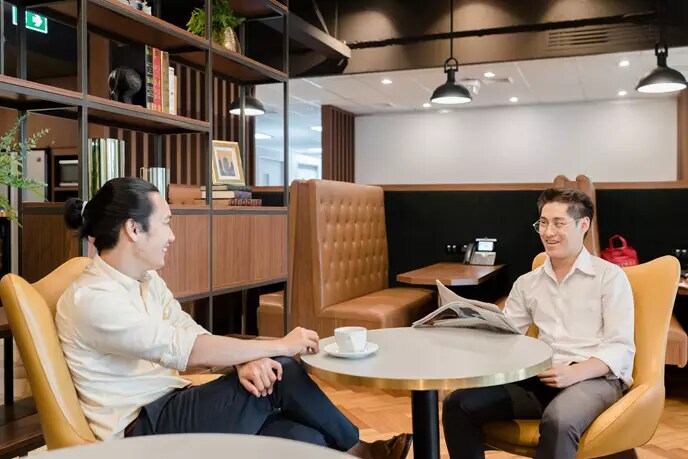
As routine work gets automated, the value of being physically together narrows to the things that resist it: building trust with a new client, resolving genuine disagreement, mentoring someone early in their career, and the messy back-and-forth of creating something original.
Employee expectations point the same way. Recent workplace surveys asked office workers across 16 countries what they hope for, and 70% said they want work that is more creative, with collaboration and autonomy close behind. On the space itself, wellness amenities, access to nature, quiet rooms for focus and areas for training all ranked above technology features. The sharpest finding comes from Gensler's earlier survey, reinforced by the 2026 results: only 14% of workers said they preferred a traditional corporate environment.
The signal is consistent: people are not asking for more desks. They want space that supports concentration, learning and human connection, and they want the flexibility to work elsewhere when the task does not require a room full of colleagues.
Why Flexibility Matters More Than Floor Space
Put those threads together and the measure of a good future workplace changes. The question stops being how much space a business holds and becomes whether that space genuinely supports what the business is doing this quarter.
It helps to be concrete about what a conventional office actually costs. A standard lease in KL commits you for around three years and comes with a deposit, fit-out, furniture, internet, utilities, and someone to answer the door and the phone. All of that is fixed. What fluctuates is your headcount, your project load, and how often anyone is actually there. Paying for peak capacity every month of the year, when teams increasingly gather only for the work that needs a room, is the single most expensive habit carried over from the old model. Space is not a neutral cost; it is capital that could have funded hiring, tools, or market entry.
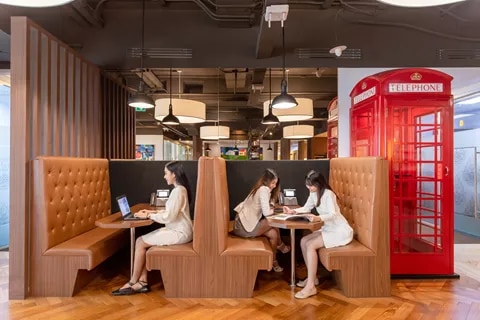
The alternative is to buy the capability rather than the square metres. Stripped back, most businesses need four things: an address clients take seriously, calls answered properly, mail handled, and somewhere credible to sit down with people. A virtual office in Kuala Lumpur with a prestigious business address at Ilham Tower in KLCC, a dedicated local number answered in your company name by a trained receptionist, mail receipt and forwarding, and 60 hours of coworking access on Servcorp's plans for focused work or client meetings. The practical difference is the risk profile: it runs from day one, costs a fraction of a lease, scales up or down as the year changes, and lets a three-person team present with the same credibility as an established firm.
That trade matters most precisely when AI is compressing how much work a small team can handle. Capability is becoming cheaper to acquire, and fixed overhead is the thing most likely to hold a lean business back.
This is not an argument that offices are finished. It is an argument that their purpose has narrowed and sharpened. Space now has to earn its place by enabling work that cannot happen any other way.
Final Thoughts
The next decade of work looks like a new division of labour: software handles the processing, people handle judgment, creativity and accountability, and physical space exists to make the difficult human parts possible. Businesses that plan around that division will spend less on space they rarely use and more on what actually moves the work forward. The practical starting point is honest and specific: look at the last month of your team's work and separate what genuinely required being in the same room from what did not. Build your workspace around the first list, and stay flexible about everything else.